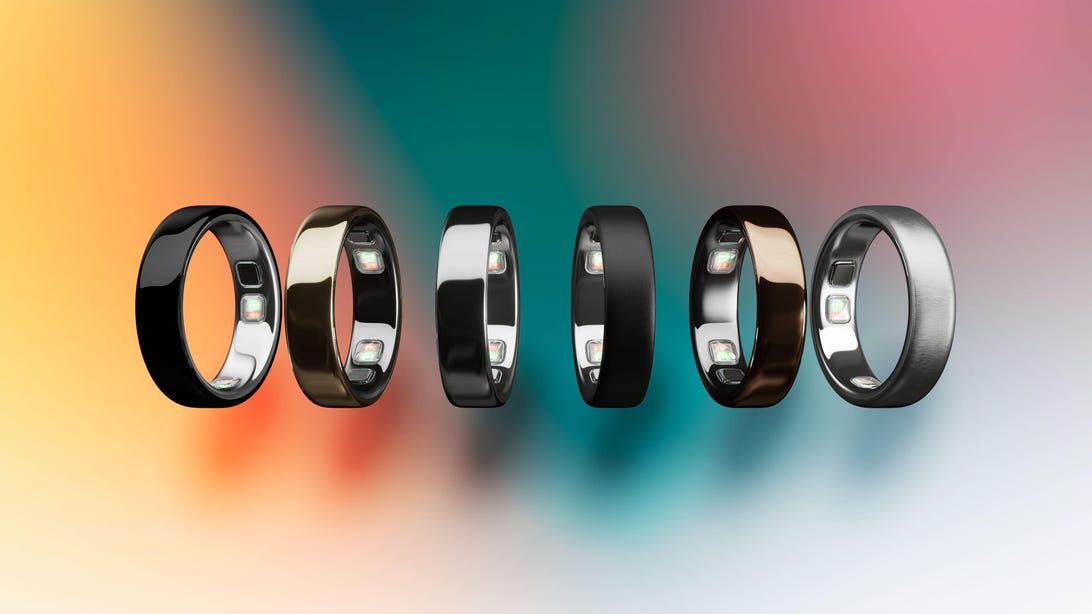
My Oura Ring 4 is the smallest, most discreet piece of technology I own, and yet sometimes I still find it too big. My preference is for dainty, rather than chunky jewelry - pretty things that will adorn my fingers, ears, wrist and neck. It’s an aesthetic choice, but I also value the comfort and practicality of smaller trinkets. The size of my current Oura Ring means that I need to remove it when lifting weights in order to get a good grip. I’d really prefer to keep my wearable technology on my body when I’m working out.
The newly announced Oura Ring 5 is a whopping 40% smaller than its predecessor. We’re talking about a matter of millimeters, but this is a significant overall reduction that will likely result in a very different wearing experience.
Our tech often requires compromises from us, and some are easier to make than others. I prefer a larger phone for the size of its screen, for example, even though I sometimes struggle to use it one-handed or fit it in my pockets. That kind of size compromise is much harder to justify with wearable tech, when you can physically feel it against your body every moment of every day.
Not only is Oura’s success in drastically reducing the size of its ring a feat of engineering, it also shows the company doing something many wearables makers have failed at for years: actively listening to customer feedback - especially from female customers - and prioritizing that feedback when designing the next iteration of the product.
Smartwatch makers, take note. We’re well over a decade into the smartwatch boom, and yet many companies are still making watches that are far too big for women’s wrists. Asking for smaller devices seems to only result in marginally diminished sizes.
That’s because many tech companies are reluctant to go back to the drawing board in the way Oura has done for the Ring 5. Reducing its size by 40% wasn’t simply a matter of shrinking it - the device needed to be reengineered from the ground up, without making trade-offs to battery life or sensing capability.
In a briefing ahead of launch, Oura explained that it rebuilt the sensing architecture inside the ring with fewer but more powerful sensing pathways. The sensing architecture was also rotated 180 degrees in places for better fit. The company redesigned the battery to be smaller while still offering a week’s worth of charge, and used more powerful LEDs to collect more accurate and consistent data despite the thinner profile.
From the outside, the Ring 5 might just look like a shrunk-down Oura Ring. Inside, it’s a completely reimagined product. It’s time for wearable tech that truly prioritizes all-day comfort - no matter how small your wrists are.
Source: Oura Ring 5 Is 40% Smaller - and a Lesson for Smartwatch Makers